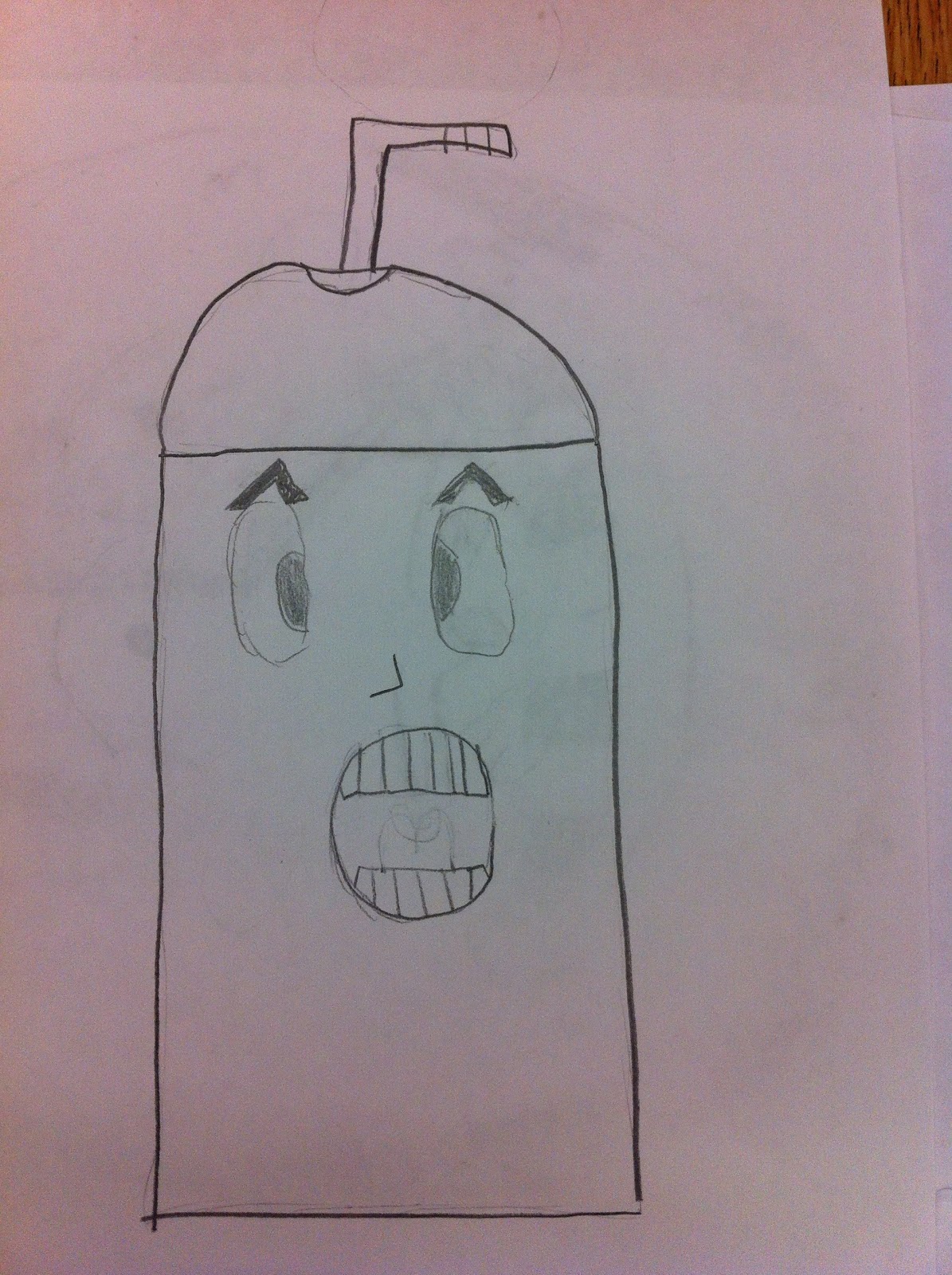
I had the class “cartoon” an object. They had to pick an inanimate object to draw first, like a water bottle, and add humanoid traits. Cartooning is a form of abstracting, so the class had to draw the object correctly before they were to abstract it to a cartoon. The art of abstracting the object is quite fun! The students were making things too big, too small, adding props, and creating strange situations, making fun and interesting characters.
Showing posts with label marker. Show all posts
Monday, April 23, 2012
Cartooning
The students requested cartooning and I love to accommodate. This lesson is so much fun because the students can really be silly and funny with their ideas and drawings. Their imaginations are filled with great ideas. They just need help to get it all on paper.
I had the class “cartoon” an object. They had to pick an inanimate object to draw first, like a water bottle, and add humanoid traits. Cartooning is a form of abstracting, so the class had to draw the object correctly before they were to abstract it to a cartoon. The art of abstracting the object is quite fun! The students were making things too big, too small, adding props, and creating strange situations, making fun and interesting characters.
We also has the student take turns teaching the class the cartoons they knew how to draw...Snoopy was a big hit.
I had the class “cartoon” an object. They had to pick an inanimate object to draw first, like a water bottle, and add humanoid traits. Cartooning is a form of abstracting, so the class had to draw the object correctly before they were to abstract it to a cartoon. The art of abstracting the object is quite fun! The students were making things too big, too small, adding props, and creating strange situations, making fun and interesting characters.
Friday, March 2, 2012
Working on Pointilism
These students are working hard on pointillism...one dot at a time....
I've asked them to draw their design on scrap paper (without the dots) to practice what will work better through dots. Textured objects work well in pointillism; veggies and fruits, animals, nature and leaves, fish and shells. We are working on small paper(thank goodness). Every point of color must be put on one dot at a time without scribbling or making small lines. Take deep breaths everyone and place your dots slowly. If you get frustrated, just take a break and come back to it later...
Here is some finished work....
Wednesday, February 15, 2012
Pointillism
Pointillism is our next project...
When two colors are right next to each other your eye mixes
them in a process called, "optical mixing." Using optical mixing
rather than physical mixing can create a brighter picture. Painting a
pointillist piece is a slow and painstaking process. Seurat's famous "A
Sunday in the Park on the Island of La Grande Jatte" (more commonly known
as "Sunday in the Park"), which covered a wall (81 inches by 120
inches), took him two years to complete. He was known for amazing devotion and
concentration. The dots in a pointillist painting can be as small as 1/16 of an
inch in diameter! Based on these measurements, "Sunday in the Park"
has approximately 3,456,000 dots!
From
Wikipedia: Pointillism is a technique of painting in which
small distinct dots of color create the impression of a wide selection of other
colors and optical blending. Aside from color "mixing" phenomena,
there is the simpler graphic phenomenon of depicted imagery emerging from
disparate points. Historically, Pointillism has been a figurative mode of
executing a painting, as opposed to an abstract modality of
expression.
The technique relies on the perceptive ability of the eye and mind of the viewer to mix the color spots into a fuller range of tones and is related closely to divisionism, a more technical variant of the method. It is a technique with few serious practitioners and is notably seen in the works of Seurat, Signac and Cross. The term Pointillism was first coined by art critics in the late 1880s to ridicule the works of these artists and is now used without its earlier mocking connotation.
Pointillism
What is Pointillism?
Pointillism is a technique of painting in which a lot of tiny
dots are combined to form a picture. The reason for doing pointillism instead
of a picture with physical mixing is that, supposedly, physically mixing colors
dulls them. Most of the painters of Seurat's time blended the colors to make a
picture with a smoother feeling than Seurat's bright, dotty works.
![]() |
| Seurat |
| Student work |
| Student Work |
![]() |
| Student work |
The technique relies on the perceptive ability of the eye and mind of the viewer to mix the color spots into a fuller range of tones and is related closely to divisionism, a more technical variant of the method. It is a technique with few serious practitioners and is notably seen in the works of Seurat, Signac and Cross. The term Pointillism was first coined by art critics in the late 1880s to ridicule the works of these artists and is now used without its earlier mocking connotation.
Monday, February 13, 2012
Working on Black Paper
These girls are working on our black paper project. They started with scrap paper to work out the design first, then they are drawing their design again on the final paper. Looks Great!
- Posted using BlogPress from my iPhone
Subscribe to:
Posts (Atom)

